
The Origins of Gift-Giving
Gift-giving is an ancient tradition and is found in all cultures across the world. Apart from helping to maintain friendly relations between individuals, it was also used as a means of building bonds of trust between different tribes or groups of people. The winter solstice, which usually falls on December 21st, was an important occasion in Neolithic times, when groups of people gathered at sacred sites to feast and exchange gifts, as well as to celebrate the return of the light at the turning point of the year. According to an early Pagan custom, it was also traditional for the Druids to give out sprigs of mistletoe at New Year to bring good fortune for the year ahead: this is the origin of kissing under a bough of mistletoe at Christmas to bring love and good luck.
In ancient Greece, Gaia the classical Goddess and personification of the Earth, was worshipped under the epithet Anesidora, which means ‘Giver of Gifts’ due to her bountiful nature, especially at harvest time. Later, in Roman times, the Festival of Saturnalia which began on December 17th and continued for six days, drew inspiration from these earlier agricultural rituals, which honoured the gifts of the harvest. This was a time for partying and feasting when social norms were overturned. Playful gifts or small figurines made of wax or pottery known as Sigillaria were often exchanged. Then as Christianity spread across the Roman world, the custom of gift-giving at mid-winter instead became associated with the Biblical story of the Magi offering gifts of gold, frankincense and myrrh to the infant Jesus at Epiphany on January 6th.
New Year & Advent Customs
In Britain, during the medieval period, people commonly exchanged gifts at New Year, with oranges and cloves being amongst the most common presents. The popular Christmas decoration of an orange stuck with cloves harks back to this period, since natural aromatics would have provided a vital protection against air-borne infections at this time. Fragrant spices such as cloves, black pepper, ginger, cardamon and cinnamon were valuable trade items in the ancient world, due to their valuable medicinal applications as well as their culinary usage. Incense materials, which included frankincense and myrrh, had entire trade routes dedicated to their transportation around the globe, being amongst the most valuable and highly prized commodities of early civilizations: suitable gifts for a new Messiah!
New Year or Hogmanay remains the biggest celebration of the year in Scotland, rather than Christmas Day. While in parts of Northern and Eastern Europe, the main celebrations take place on Christmas Eve, with gifts being exchanged at the beginning of Advent, on December 6th at the feast day of St Nicholas, the patron saint of children. Legend has it that St Nicholas secretly helped a poor man who didn’t have enough money to provide dowries for his three daughters, by dropping bags of gold down the chimney into their stockings that were hanging by the fire to dry. This folktale is the reason why children still traditionally hang their stockings beside the fireplace today at Christmas.
Early Christmas Traditions
Traditionally Christmas Day in Britain was an occasion for feasting, drinking and rowdy behaviour. Groups of young men would go from door to door, singing carols and offering members from each house a drink from their wassail bowl, in exchange for token gifts. The figure of Father Christmas in this era was more the master of ceremonies for the revellers, rather than a bearer of gifts for children!
In Britain and America, the popularity of giving gifts to children at Christmas can be traced to the growing popularity of Santa Claus, via Dutch settlers to the US who had taken stories of St Nicholas (known as Sinterklaas) with them. Over time in Britain, the custom of gift-giving moved to Christmas rather than New Year, with Santa Claus traditionally delivering presents to children on Christmas Eve, which were allowed to be opened in the morning of Christmas Day. However, in other parts of the world, children receive their presents on different days: in Belgium, Germany and parts of Eastern Europe, presents are still unwrapped on St Nicholas’s day, while in Catholic countries such as Spain, Italy and Mexico, children open their gifts at Epiphany on the January 6th.
There is also a widespread European tradition of giving gifts to the poor on the day after Christmas, the day of St Stephen, the patron saint of the poor. Boxing Day is possibly named after the alms box placed in local parish churches to collect donations for the poor, or the box of gifts, known as ‘Christmas Boxes’, traditionally given to servants each year by the owners of wealthy houses.
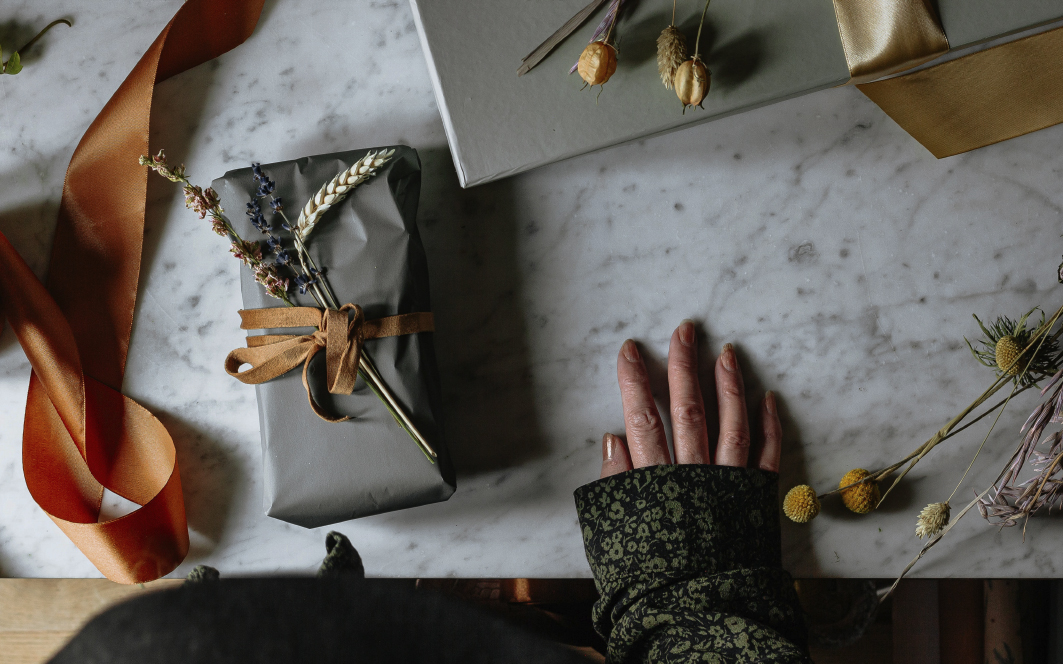
The exchanging of Christmas cards is a Victorian invention, started by a government official of the Post Office and was looking for ways to encourage ordinary people to use the postal service! Around the same time, the practice of wrapping presents in ornate gift paper started to become popular in England. The tradition was popularised in North America by a private company, Hallmark Cards, whereas up until the 19th century presents were offered or displayed unwrapped. The placing of presents under the Christmas tree was also inspired by the Victorians. Small gifts were also hung from the tree or placed beneath it, such as mandarins, dried fruits, nuts, sweets or small handmade trinkets.
Festive Aromatic Gifting
Natural aromatics make perfect Christmas gifts, and there are also plenty of ways to get creative too. Christmas presents don’t need to be expensive, as it can be fun to make your own presents, especially for children! Lots of ideas and recipes for getting hands-on can be found in my recent book ‘Mud Salt + Medicine’ and in the ‘Blending Notebook’. Festive essential oils such as our range of natural room fragrance diffusion blends make ideal stocking fillers for adults, while aromatic soaps or flower waters make lovely gifts for children. We have also introduced a curated range of Gift Boxes which are all 100% natural, eco- friendly and packaged using recycled / recyclable materials, many of which are unisex in appeal.