
Ceremonies for the land no doubt existed, but it seems they did not survive … I think there is wisdom in regenerating them here, as a means to form bonds with the land. To have agency in the world, ceremonies should be reciprocal, co-creations, organic, in nature, in which the community creates ceremony, and the ceremony creates communities.
The Symbolic Significance of Evergreen Plants
Connecting with the changing seasons, with the landscape and the plants that grow around us, was once second nature. This is still evident during festivals and seasonal celebrations, although much of the symbolic significance of these ancient rites has been lost. Lighting candles, making hand-made gifts and gathering botanicals to decorate the home at Christmas is an age-old tradition.
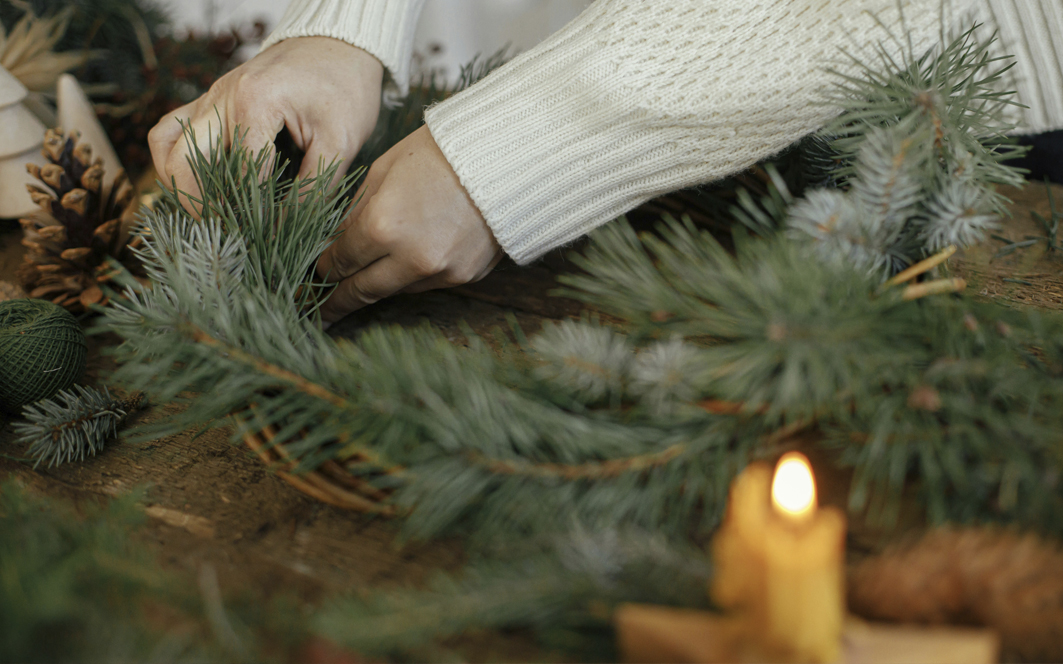
For example, wreath-making has a strong connection with the Winter Solstice, when pine, bay, holly, ivy and mistletoe, are some of the traditional plants used to make garlands, where each has a symbolic meaning. Evergreens have long been used for creating winter decorations, since they represent the continuity of life when all other plants appear to have died. Holly, ivy and mistletoe were held in special regard because they bore berries in the middle of winter, signifying rebirth. In Norway and Sweden, the holly tree is called ‘Christ’s Thorn’ and it’s suggested that the English name ‘Holly’ may well derive from the word ‘holy’ as it mimics the thorns placed on the head of Christ.
Today it’s still customary to hang up a bunch of mistletoe to kiss beneath at Christmas but mistletoe was once hung in the hallway of houses all year round, because when guests greeted each other upon arrival, it was a sign that they would be safe within that place. Mistletoe was also endowed with qualities of power, fertility and protection – a plant sacred to the Druids – as it was believed to have magical properties.
The Role of Botanical Aromatics at Christmas
Botanical aromatics have always played a central role at Christmas: the uplifting quality of refreshing citrus scents, the warmth of spices, richly fragrant incense and sumptuous perfumes all help to bring a sense of comfort and joy into the darkest months of the year. My latest book ‘The Botanical Home: Your Complete Guide to Using Plants to Scent, Cleanse & Enhance your Home’, contains over 50 ideas for making DIY recipes and crafts to enjoy at home in the lead up to Christmas.
Here are a couple of ideas to get you started…
Natural Scented Festive Room Freshener:
You can make a simple room fragrance mist with our witch hazel water in one of our empty 100ml blue glass bottles with atomiser top with water and a little alcohol to help prolong its shelf life. This spray can be enjoyed in any room – spritzed onto, cushions, rugs or fabrics – but best avoided on silk or very delicate items. A top tip is to spray onto a warm radiator to help circulate the scent.
The aromatic room spray will instantly impart a transformative effect on your environment – a particularly enjoyable thing to do during the festive season to scent your home or personalised card, gifts or decorations.
NOTE: This product is not designed for use on the skin so avoid contact with the face and body.
Ingredients:
- 1 tsp witch hazel (or ½ tsp vodka or another pure fragrance-free alcohol)
- 95ml purified water
- 50 drops (in total) of essential oils to suit your preference
Christmas Blend: 15 drops orange, 15 drops cypress, 10 drops black pepper, 10 drops nutmeg
Winter Blend: 15 drops juniper berry, 15 drops mandarin, 10 drops frankincense, 10 drops clove
Method:
- Pour the witch hazel or alcohol into your bottle
- Add 50 drops of chosen essential oils
- Fill up with purified water
- Place the cap on and shake vigorously to combine
Aromatic Wax Melts:
These mini aromatic cubes create a sense of simple luxury at home and are a lovely way to scent a room using a traditional oil burner. Essential oils which have a good staying power – such as lemon, grapefruit, lavender, geranium or rosemary – are best used when making aromatic candles and wax melts. Resinous and balsamic oils such as myrrh, benzoin, frankincense or amyris also work well combined in this recipe due to their tenacious quality and are perfect for the Christmas season.
Ingredients:
- 200gm (7oz) soy or vegetable wax flakes
- 30 drops of essential oils of your choice
- dried rose petals (optional)
Equipment:
- Saucepan
- Heat-proof jug
- Silicon ice cube tray
- Glass stirring rod
- Traditional oil burner
- Airtight container
Method:
- Put the wax flaxes into the heat-proof jug and place in a saucepan of water.
- Simmer over a low heat until the wax has melted completely and it is hot.
- Add the 30 drops of essential oils -see suggestions below – and stir well.
- Prepare the moulds by scattering a few rose petals into the base of the silicon tray (optional).
- Carefully pour the aromatic wax into the moulds and set aside to cool.
- Once hardened, the cubes can be removed from the tray gently.
- To use, place one wax melt into the upper bowl of an oil burner, light the candle and allow the wax to melt infusing the room with its scent which can last for up to 12 hours.
- Store any remaining melts in an airtight tin (or jar) and they will be good for up to 2 years.